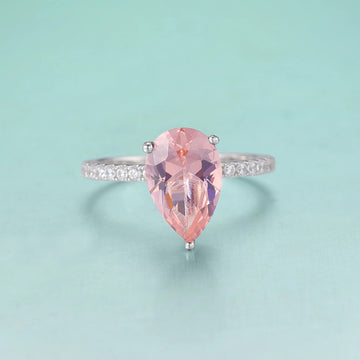
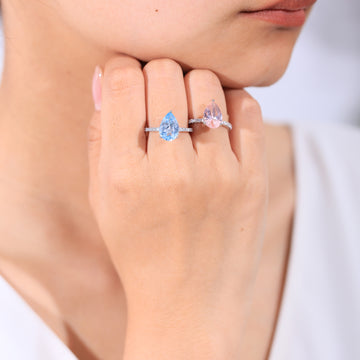
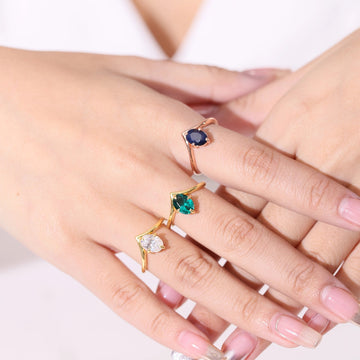
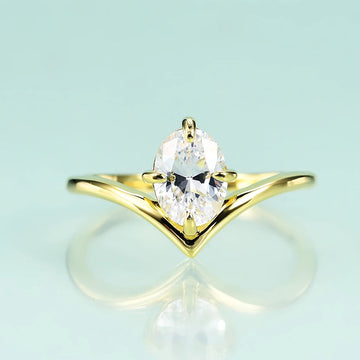
Walk into a jewelry store. Ask about lab-grown diamonds. Watch the smile tighten.
For years that was the whole script. A polite pivot back to the mined trays. "Of course, sir, but let me show you something with real history…"
That script is dead.
Lab-grown center stones now sit in 61% of US engagement rings. The Knot's 2026 Real Weddings Study put hard numbers on it: a 239% jump since 2020. Average stone, 1.9 carats. Average spend, about $4,600.
Read that again. The mined diamond didn't lose to some fringe alternative. It lost to the new normal.
So forget the question everyone argues about online. "Is a lab-grown diamond real?" Yes. Done. The chemistry settles it in two sentences and we'll get there.
Here's the question that actually decides your purchase: what are you trying to win?
Because this isn't one decision. It's four, stacked on top of each other and pretending to be one.
You might want the biggest stone your budget can buy. You might be thinking about resale years from now. You might care about the environmental side. Or you might just want the ring to mean something specific.
Four different goals. Four different answers. And any guide that wraps it up in one neat recommendation is selling you its affiliate link, not the truth.
Let's go through the three things you can actually measure. Plus the two places where the marketing fogs the glass on purpose.
Both of these are diamonds. Full stop.
The US Federal Trade Commission ended this fight back in 2018.
It rewrote its Jewelry Guides. It deleted the word "natural" from the official definition of a diamond. And it banned sellers from calling lab-grown stones "fake" or "synthetic."
So here's what you're really comparing: the same thing, twice.
Pure carbon. Cubic crystal lattice. A 10 on the Mohs hardness scale, the maximum. Refractive index of 2.42. The sparkle is identical because the physics is identical.
The only difference? Where the carbon crystallized. That's the entire debate.
How the lab versions get made is worth 30 seconds, because the method lands on grading reports and people misread it as a quality score. It isn't one.
CVD (Chemical Vapor Deposition). A thin diamond "seed" goes into a vacuum chamber. Carbon-rich gas, usually methane, feeds it. Carbon settles onto the seed layer by layer over a few weeks. Slow. Precise. Now the go-to for bigger gem-quality stones.
HPHT (High Pressure High Temperature). The brute-force route. Crushing heat and pressure on a carbon source, basically a copy of conditions deep in the earth's mantle. Older method, still useful, especially when deep color matters more than flawless clarity.
Neither one is "better." Same labs grade both, same checklist.
And the mined stones? Their backstory is genuinely dramatic. Formed one to three billion years ago, 150 to 200 km underground, under conditions that no longer exist near the surface. Hauled up through kimberlite volcanic pipes, which is why mining clumps into a handful of countries.
That's where the whole "rarity" pitch comes from. And here's the part I'll hand to the natural-diamond camp, because most of their marketing is air, but this bit isn't: big, clean gem-quality crystals really are scarce in the ground. The scarcity is real. Whether you should pay a fortune for it is the open question.
Price: the headline number is hiding something
At matched grades, lab-grown runs roughly 70 to 80 percent cheaper than mined.
True. And built to mislead you.
The fact almost nobody knows walking in: the gap gets wider as the stone gets bigger.
The reason is pure math.
Natural prices climb non-linearly. Double the carat weight and you more than double the price, because large clean crystals are exponentially rarer in nature. Lab-grown climbs almost in a straight line, because a production line doesn't depend on geological luck.
Two curves. Pulling apart. Fast. Especially past a carat.
Here are rough early-2026 retail ranges for a comparable round, well-cut stone around G color and VS clarity. Watch the lab-grown column. It keeps sliding down.
|
Carat |
Natural (retail) |
Lab-grown (retail) |
What the gap feels like |
|
0.5 ct |
$1,000 – $1,800 |
$120 – $280 |
Big percentage, small dollars |
|
1.0 ct |
$4,000 – $6,500 |
$400 – $900 |
Where most buyers flip |
|
1.5 ct |
$8,000 – $13,000 |
$700 – $1,400 |
The price of a used car |
|
2.0 ct |
$16,000 – $32,000 |
$1,200 – $2,800 |
A whole second car |
|
3.0 ct |
$35,000 – $70,000 |
$2,500 – $5,500 |
A down payment |
Read it across, not down.
At half a carat, going lab-grown saves you maybe a thousand bucks. Nice. Not life-changing.
At one carat, it becomes the thing you actually decide on.
At two carats, the difference pays for the honeymoon and still has change left.
The savings hiding inside the 4Cs
Now the part even careful shoppers walk right past.
Lab-grown pricing flattens the trade-offs baked into the 4Cs.
In a mined diamond, nudging color up one grade (say H to G) adds 10 to 15 percent. Jumping VS2 clarity to VVS1 adds 20 to 30 percent. Real money. Real compromise.
In a lab-grown stone? Those same two upgrades cost you maybe $100 to $200 total.
You see it in the percentage. You barely feel it in the wallet.
So throw out the old advice. With mined diamonds, the standard line is "settle." Take H or I color. Live with SI1. Keep the bill sane.
With lab-grown, you can reach for F or G color and VS2 or cleaner, and the budget won't blink.
And here's a free tip that saves you cash: a well-cut SI1 lab stone is usually "eye-clean" already, meaning zero inclusions visible without a loupe. Paying up for higher clarity buys you something only a microscope will ever see.
Put that saved money into cut instead. Cut is the C that makes the thing throw light. The rest is bragging rights.
Why the mall counter marks lab-grown up so hard
One number explains a lot of jeweler behavior.
At wholesale, lab-grown sits around 98 percent below mined. At retail, that gap shrinks to roughly 80 to 89 percent.
That difference isn't shipping. It isn't insurance. It's margin.
Chain jewelers keep fat markups on lab-grown on purpose, so it doesn't undercut the mined inventory paying their rent.
Buy from a specialist instead, online or off, and more of that wholesale gap stays in your pocket where it belongs.
Durability: the shortest section here, and it's not close
Both stones hit a 10 on Mohs. The ceiling. Harder than any other gem material on earth.
Same refractive index. Same thermal conductivity, which is literally one of the tests gemologists use to catch a glass impostor.
A lab-grown diamond will not scratch sooner. Will not chip easier. Will not lose its sparkle over the years.
If a salesperson tells you one is "tougher" than the other, in either direction, they're arguing with the measurements. Tune it out.
One honest footnote. A small slice of lab-grown stones get annealed after growth, heat and pressure applied to bump the color grade. It's permanent. It doesn't touch durability. But it's fair to ask about, since untreated stones (lab or mined) are what collectors quietly prefer. You might as well know exactly what's on the finger.
Resale: the strongest case for mined. Until you do the math.
This is where the natural-diamond pitch gets loud. "They hold their value." "It's an investment."
Fine. Let's run the actual numbers.
One term first, because it's the only figure that touches your bank account. Call it the effective loss. Purchase price minus what you realistically get back later.
Not the resale percentage. The dollars that don't come home.
Mined diamonds usually resell for 25 to 60 percent of original retail. Depends hard on size, quality, and where you sell. A $5,000 mined ring might bring back $1,500 to $3,000. Real money. Well short of whole. (Dedicated buyback services like WP Diamonds or Worthy, or a solid estate jeweler, beat a pawn shop or a marketplace listing, sometimes by a lot. These are directional numbers, not a quote. Individual stones swing all over the place.)
Lab-grown resells for about 10 to 20 percent of retail. Worse as a percentage, no argument. The secondary market is young, and since new production keeps getting cheaper, your stone competes against next year's cheaper stone.
Now watch the percentage lie to you.
Same 1.5-carat ring. $11,000 as mined, or $1,500 as lab-grown.
The mined stone resells at ~36 percent. You recover about $4,000. Effective loss: ~$7,000.
The lab-grown resells at ~18 percent. You recover about $270. Effective loss: ~$1,230.
The mined stone's "better" resale percentage doesn't save it. Because it's a better slice of a much bigger number.
On the figure that actually hits your wallet, lab-grown wins by roughly $5,700.
Here's the truth nobody at the counter says out loud: an engagement ring is not an investment. Not in any material.
Almost everything you buy loses value. A car drops 60 percent in five years. A phone is nearly worthless in three.
The resale question genuinely bites in exactly two situations: divorce and estate liquidation. And even there, the lower starting price usually comes out ahead.
If you're buying a ring partly to store value, the honest move isn't a mined diamond. It's a different asset entirely.
Certification: get the paper. Every time.
Both stone types get graded on the same 4Cs by the same institutions.
GIA (Gemological Institute of America). IGI (International Gemological Institute). You'll also see GCAL on lab-grown reports.
The formats and criteria are basically identical. GIA marks its lab-grown reports distinctly and laser-inscribes a unique ID on the girdle of the stone.
Three rules that keep you out of trouble:
Buy certified. Always. GIA, IGI, or GCAL. Mined or grown. An uncertified stone is unverifiable no matter how good the price looks. "Trust me" is not a grading lab.
Know the labs. IGI shows up more on lab-grown. GIA leans mined and has long been the stricter grader. Both are legit. When a deal hangs on one color grade, the lab that issued the report matters as much as the grade.
The certificate is for the stone, not the ring. Buying a finished piece? Ask for the original stone report, then check that the laser inscription on the girdle matches the number on the paper. Mismatches happen. Not always by accident.
Ethics and environment: messier than either pitch
Here's where both sides oversell. So let me lay out the real shape of it.
Lab-grown gets sold as the obviously ethical choice. No mining. No conflict zones. No exploited labor.
And there's truth in it. Mining carries real costs. Torn-up land. Water use that some estimates put at five or six times more per carat than synthesis. Emissions off the heavy equipment. The Kimberley Process cut conflict-diamond flows but never got them to zero. Growing a stone skips all of that.
But here's the part the cheerful version leaves out.
Growing diamonds eats electricity. A single 1-carat CVD stone burns through well over 250 kWh. And in several of the big production countries, that power still comes largely from fossil fuels. Peer-reviewed work has flagged just how capital- and energy-hungry both HPHT and CVD really are per carat. The synthesis is not the tidy little countertop process the branding suggests.
So "lab-grown" tells you nothing about the grid behind it. The label covers genuinely carbon-neutral producers running on renewables, and outfits running on coal. Both.
The real question isn't lab or mined. It's whose lab, on what power.
A few producers (Diamond Foundry among them) document renewable energy and verified carbon-neutral stones. Plenty of others stay quiet, because there's nothing flattering to say.
On the mined side, the cleaner sources are audited operations in Canada, Botswana, or Namibia, sold with full chain-of-custody paperwork. They cost more than the average mined stone. But the ethics hold up when you push on them.
Sell these stones and track real sourcing data? Verified energy for your lab-grown, chain-of-custody for your mined inventory? Publish the actual numbers right here. A real table of producer, method, energy source, and certification is almost impossible for a competitor to copy, and it's exactly the kind of original proof that gets a page trusted instead of skimmed.
So which one, actually?
Strip the philosophy. It comes down to what you're optimizing for.
Go lab-grown if: you want the most visible stone your budget allows, especially past a carat. You'd love to splurge on color and clarity for almost nothing. You don't see the ring as a financial asset. You'd rather have a controlled production line than a tangled mining supply chain.
Go mined if: you're shopping above three carats, where lab supply is still thinner. The geological backstory genuinely matters to you or your partner. You're buying from a heritage house whose whole pitch is provenance. You want the established (if modest) resale infrastructure. Or you want a fancy color, because natural yellows, pinks, and blues carry a serious collector premium the lab versions can't touch, even though they cost a fraction to make.
And the bracket where this whole debate barely matters: under about $1,500, simple solitaire, below three-quarters of a carat. The visual difference is nothing. The resale of either is small. The footprint of either is minor. Just pick the story you want the ring to carry. The measurable outcomes are a tie.
Same logic for a vintage or heirloom stone. That question's already answered. The only real choice left is the setting.
Questions people actually ask
Can a jeweler spot the difference just by looking? No. Telling them apart reliably takes equipment that reads trace elements and growth patterns. By eye, with a loupe, in normal light, even a seasoned jeweler can't call it. Which means nobody knows unless you tell them. "What will people think" is a non-issue.
Will lab-grown prices keep falling? Probably. Especially at smaller sizes, because capacity is outrunning demand. That's also why resale is weak: today's stone competes with cheaper stones a couple of years out. If long-term value matters, take it seriously. If you only care how the ring looks the day you give it, ignore it.
Aren't lab-grown diamonds basically moissanite or cubic zirconia? No. And this mix-up robs lab-grown of credit it's earned. Moissanite is silicon carbide. Cubic zirconia is zirconium dioxide. Different materials, different optics, different hardness. A lab-grown diamond is chemically identical to a mined one. The three only get lumped together as "diamond alternatives," which is fair for two of them and flat wrong for the third.
Does a mined diamond gain value over time? Usually not. Not at engagement-ring sizes and grades. Truly investment-grade stones (large, exceptional color and clarity, documented provenance, north of $50,000) can appreciate. A 1-carat retail engagement diamond is a consumer purchase. Same as a new sofa.
Do insurers treat the two differently? They cover both, at different replacement values matching the different prices, so lab-grown coverage costs less. Premiums usually run as a percentage of insured value. Get one thing right: insure what you actually paid, not some inflated appraisal built to make the ring feel expensive.
Any visual difference at all? None to the naked eye. None under a loupe. None in normal light. The differences live in trace-element composition (sometimes catchable under UV) and microscopic growth structure (visible only on lab equipment). Fire, brilliance, sparkle: identical. Because the physics is identical.
What about financing and upgrade programs? Ask before you buy, because the terms vary wildly. Some sellers offer lifetime upgrade credit toward a bigger stone. That plays out very differently for lab-grown (where trading up is cheap) than for mined (where you're chasing a higher moving price). Check whether the credit covers the stone only or the full purchase, and whether lab-grown trade-ins even qualify. Several houses quietly leave them out.