Pear vs Marquise Vintage Rings: Which Cut Actually Survives the Next 50 Years?
Jun 19, 2026
Sometime in the 1700s, the story goes, King Louis XV looked at his mistress's smile and commissioned a diamond cut to match the shape of her mouth.
That's the marquise. A ring born as a royal flex.
The pear came almost three centuries earlier. A Flemish cutter named Lodewyk van Berckem shaped the first one in 1458, which makes it one of the oldest faceted diamond shapes still in production.
Two cuts. Centuries of history apiece. Both sitting in antique cases right now, waiting for a buyer.
And both carrying the same weakness: a pointed end that has to survive decades of daily wear without chipping.
So which one ages better?
Careful with that question. It's hiding three questions inside one.
It can mean which cut physically outlasts the other. It can mean which cut still looks wearable in 40 years instead of dated. Or it can mean which cut holds its value in the collector market.
Three questions. And they don't all point to the same cut.
"Ages better" is three different bets
Most articles on this blur the three together. That's a mistake, because they're not the same thing.
A cut that physically survives decades isn't automatically the one that stays in style. And neither is automatically the one that keeps its money.
With vintage rings, all three matter at once. Because the ring has already aged. The whole question is whether it keeps aging well.
Here's how they break down:
Physical durability comes down to the cut's weak points and how well the original setting protected them.
Aesthetic longevity comes down to how tightly the cut is chained to one era's look.
Collector value comes down to supply (how many real antique examples exist) and demand (whether anyone still wants the shape).
On every one of those axes, pear and marquise pull apart. Let's go.
Durability: one point versus two
A diamond is the hardest natural material on earth. A 10 on the Mohs scale.
But here's what the salespeople skip: hardness measures scratch resistance. Not impact resistance. A diamond can absolutely chip. And the thinner or more pointed a section is, the easier it cracks from a knock that would bounce off a rounder stone.
Now look at the two cuts.
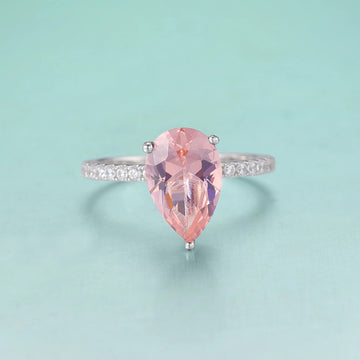
The pear has one pointed tip at the narrow end. The rest is a rounded belly, structurally tough.
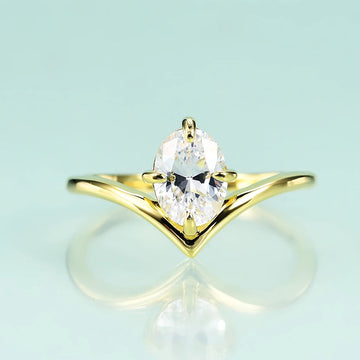
The marquise has two pointed tips, one on each end.
Do the math: the marquise has twice the surface area at risk.
In practice it's worse than double. Both marquise tips catch on fabric, hair, and hard edges. The pear's single tip doesn't, because the rounded belly acts as a bumper when the ring rubs against a surface. A marquise has no protected zone like that. Nowhere to hide.
Set well, both cuts can ride out 50 or 100 years with their points intact. Set badly, or knocked around? Marquise tips chip more. Often.
Walk through any reputable estate jeweler's case and you'll see it with your own eyes: more antique marquise rings show tip wear or restoration than pears of the same age.
Why the year it was cut matters as much as the stone
Vintage stones were cut by hand. No lasers. No computers.
Hand-cut antique marquises and pears often have slightly crooked points, off-center culets, unevenly spread facets. That's part of the charm. It's personality modern computer-cut stones can't fake.
But it also changes how force travels through the stone on impact. An asymmetric point is more likely to chip along a stress line.
So the cutting era matters as much as the stone itself. Here's the quick map:
Late Victorian and Edwardian cuts, roughly 1880 to 1915, were the peak of hand-cutting skill. These cutters had spent decades reading crystal stress lines by feel.
Art Deco cuts, the 1920s and 30s, brought in tighter geometric precision.
Mid-century cuts, 1950s and 60s, were all over the map on quality.
From the 1970s on, stones start approaching modern standards.
The takeaway is blunt: a pear from 1905, cut by a skilled Edwardian master, can outlast a marquise from 1975 cut by some mediocre commercial shop. Shape theory loses to craftsmanship.
Style: which one won't look like a costume in 40 years
This is where the two cuts split hardest.
Pear has held steady for 500 years. Never the dominant shape. Never out of fashion either. Royals have worn pears in nearly every era. Designers keep putting them in collections. Pear-shaped engagement rings have stayed mainstream enough that they don't scream "a specific decade."
Marquise has a narrower window.
It got locked to the 1960s, 70s, and 80s, when it was practically the default engagement choice. And that association stuck. A marquise on the finger can read as "1980s" in a way a pear never reads as "specifically the 1980s."
Not always, to be fair. A real 1920s Art Deco marquise reads as Art Deco, not as dated. But the general perception of the cut carries more era-baggage than pear does.
If you're wearing this thing for the next four or five decades, that's a real factor.
A genuine 1920s Art Deco marquise will probably keep looking Art Deco. A 1980s marquise solitaire is harder to place in a modern context. Pear ages more neutrally. It tends to read as the era of its setting, not the era of its cut.
The popularity cycle nobody warns you about
Diamond cut popularity moves in waves.
Marquise ruled from roughly 1965 to 1990. Then it crashed. Now it's in a quiet comeback.
Pear has been steadier, with smaller peaks, the latest one pushed hard by celebrity picks.
Here's why that's asymmetric. Buy a marquise during one of its boom years and your ring competes, visually, against a flood of near-identical stones from the same era. Buy a pear in any era and it looks less tied to its moment.
The setting: where vintage marquise rings quietly lost
Often the setting decides whether a vintage stone survives, more than the cut does.
And this is where vintage marquise rings have the worse track record.
V-shaped prongs, designed specifically to cap and shield pointed tips, became standard in the mid-20th century. Earlier rings (Victorian, Edwardian, early Art Deco) used simpler prongs that left the tips exposed.
Both shapes from those eras can show tip damage as a result. But the marquise, with two exposed points, was twice as exposed.
So when you're sizing up a real antique marquise, put both tips under magnification and look hard. Restoration is common. A re-pointed marquise (where a chip got polished back into a clean point) is acceptable, but it should knock the price down.
A pear has only one tip to inspect. Which makes judging its condition simpler and more reliable. One point of failure instead of two.
Restoration math also favors the pear
Fixing a damaged marquise means removing material from both ends. If the original symmetry was already off, restoring it can cost you real carat weight.
Fixing a pear means dealing with the single point. That's it.
Over a lifetime of ownership, a vintage pear is simply a lower-maintenance asset than a vintage marquise.
Collector value: where the marquise market splits in two
The antique market runs on its own logic. Rarity, condition, provenance, era-demand, all tangled together. And "ages better" in money terms isn't always "ages better" in physical or style terms.
Pear in the antique market. Antique pears, especially old mine cut and old European cut pears from the 1800s, have climbed steadily for decades. Buyers want them because they pair vintage hand-cut character with a shape that doesn't feel dated. Supply was always limited (cutting yields favor rounds, so historical pear output ran lower), and demand keeps growing as people chase cuts with character over computer-cut perfection. A genuine pre-1920 hand-cut pear in good shape routinely beats inflation at the dealer counter.
Marquise in the antique market. This one splits down the middle. Genuine Art Deco marquises from the 1920s and 30s, especially platinum filigree pieces, pull strong prices. But mid-century commercial marquises from the 60s through 80s are everywhere, often with undistinguished cuts, and they haven't appreciated much.
So the market really divides into two things. "Art Deco marquise," a real collector category. And "vintage marquise" in the loose sense, which usually means recent decades and carries a lower premium.
For anyone thinking long-term: a vintage pear from almost any year between 1880 and 1950 has a coherent collector market. A vintage marquise has a strong one for certain eras and a weak one for others. You have to know which marquise you're holding.
How each cut ages on a hand that's also aging
Here's a quieter factor nobody measures, but it's real.
Hands change over the decades. Knuckles thicken. Skin loses its snap. Finger proportions shift.
A cut that flatters at 30 can sit differently at 60.
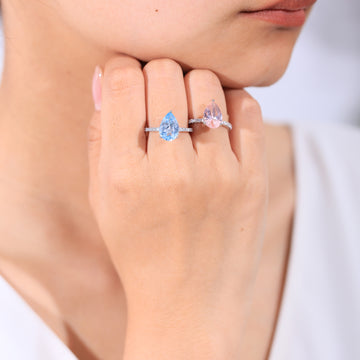
Pear forgives all of that. The rounded belly and soft taper flatter most hand shapes and don't get exaggerated as hands change. The single point gives you elegant direction without aggressive geometry.
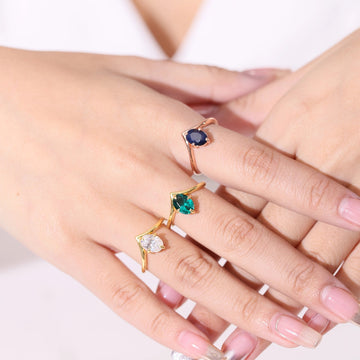
Marquise is pickier. It looks best on longer fingers and can read out of proportion on shorter or thicker ones. And the long, slim finger you have at 28 may not be the finger you have at 68.
This is a quiet reason marquise rings sometimes get reset into other shapes by their owners decades later. Pears get reset far less often.
So who should buy which?
A vintage pear ages better for you if: You want a cut that won't read as era-specific across the decades. You'll wear the ring daily and want the lowest chip risk. You care about steady collector value across most antique eras. Or your hand shape might change noticeably with age (and whose doesn't?).
A vintage marquise ages better for you if: You're specifically drawn to Art Deco and want a cut that defines that era. You want the dramatic, statement silhouette regardless of any era baggage. You're willing to commit to V-prong settings and yearly prong checks. And you're buying genuine 1920s–30s pieces from that coherent collector category, not random recent stock.
When the vintage premium isn't worth it. Either cut.
Let's be honest about the cases where this whole conversation doesn't apply.
If you work with your hands all day. Vintage pointed cuts in original vintage settings, however charming, are higher-risk than a modern lab-grown stone in a tough modern setting. The vintage premium is paying for character that chips away one knock at a time.
If the ring lives at the gym, the pool, or the stove. Both cuts are vulnerable here. A modern bezel-set round in 14k gold is just the better tool for that life.
If you can't verify the era and condition. "Vintage-inspired" is not vintage. Plenty of sellers blur that line on purpose. If you're paying a vintage price, demand the proof: original receipts, era-consistent hallmarks, or authentication from a reputable estate dealer. No paper, no premium. Otherwise you're paying antique money for a recent reproduction.
If the original setting is beyond repair. Sometimes the stone is worth keeping but the setting has degraded past saving. At that point the "vintage" character is mostly gone. A stone reset into a modern setting is a different object, and the whole money equation changes.
The honest verdict
Pear ages better on most of the axes that matter to most buyers. Physical durability. Style longevity. Broad collector demand. Forgiveness as your hand changes over the years.
Marquise can age better in specific situations, mainly genuine Art Deco pieces bought and worn by someone who knows exactly what the cut signals.
But that's the catch. With a marquise, you have to know which marquise you're buying.
With a pear, the cut does more of the work for you.